

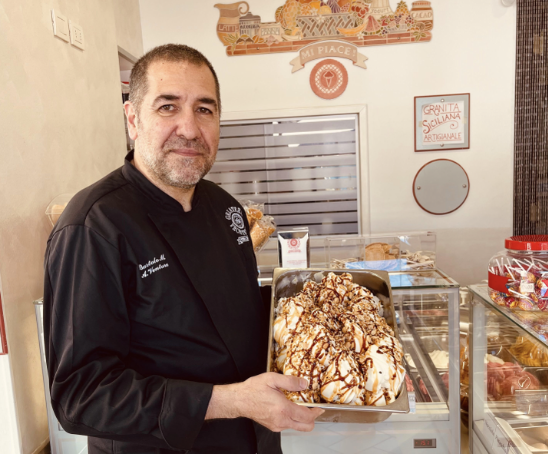
It’s a cold and windy weekend in mid-September when I meet a practically unknown gelato maker. He owns the 281 Frontelago parlor in a small town of about two thousand inhabitants near the Swiss border, right on the lake—Porto Ceresio, in the province of Varese. This is how a long and pleasant chat begins. For Bartolo, gelato is the expression of his creativity, honed over many years of apprenticeship (“gavetta”) working for others around Italy. He uses only natural ingredients sourced from territories known for their native produce, pouring all the passion he’s had since he was a child into his work. His dream started when he was 8 years old in Sicily, at his uncle’s gelato shop in Donna Lucata (Ragusa). He was fascinated and in love with the gelato his uncle made by pouring a liquid mixture into an old Carpigiani SED L20 machine.
Over the years, he spent more than ten years doing his apprenticeship, traveling all over Italy and training alongside various gelato makers he met what today you’d call “on-the-job training”. However, to perfect his own unique “recipes,” he later attended various specialization courses, this time in a classroom. This led him to also offer granitas, hardpacked ice cream (“pezzi duri”), savory gelato (“gelato gastronomico”), and more.
Although he was born and raised on Lake Maggiore, he started working in the sector in Varese, behind the counter at his sister’s gelato shop. Only after some time did he move into the lab with the elderly Puglian master gelato maker, who truly initiated him into the profession. After that, he gained various experiences in Lombardy, Piedmont, Lazio, and other regions. His experiences also include one in Austria, where he ran a traveling van on the outskirts of Salzburg. There, by reselling gelato produced by another Italian, he built up a successful route that is still active today. In the meantime, he married a woman from Marche and settled in Imola. He took over the management of the “Al 281” gelato shop, starting to produce “his” more natural and distinctly different gelato—less “industrial,” more “Sicilian”—compared to the typical Emilian style. After a brief “transition” period, the feedback was very positive. This was thanks in part to his fruit sorbets and granitas, which were not commonly found in the area. However, after a few years, noticing a shift in consumption from the city center to “shopping centers,” he decided to leave and invest in his own shop. In 2019, he took over the second historic gelato shop in Ponte Ceresio, renaming it 281 Frontelago as a reference to his last successful entrepreneurial adventure. He opened in March but almost immediately had to face the pandemic period. That certainly didn’t discourage him, though, bolstered by the moral support of his wife, who is always ready and smiling at the counter while he lets his imagination run wild in his small lab. Despite everything, his revenue has grown every year since then, thanks also to the increasing number of tourists, mainly from Switzerland. Twenty-four gelato flavors are displayed in the showcase, with 4 of them (two creams and two fruit flavors) on rotation. During summer weekends, he sells up to 300kg of gelato, thanks to the rotation of the many flavors he’s created over the years—about 300 so far. Meanwhile, at the end of the season in October, many loyal customers stock up on tubs for the winter. While Bartolo produces the gelato, his wife handles the cakes, but only made-to-order. They alternate working in the small, nine-square-meter laboratory.
In recent years, Bartolo has also participated in some competitions. He had previously snubbed them, partly due to industry gossip and partly because of a disappointment way back in 2010. In fact, the first competition he entered was a return to his past: the Grand Prix Austria in Salzburg, organized by our magazine, which took place in March 2023. He won for the best dark chocolate.